

Area alone is not enough
If the whole growing layer is replaced, calculate the whole new layer. If suitable existing soil stays, calculate only the layer to add or replace. Work out areas and layers with different depths separately, then add their volumes. Topsoil, compost and potting mix are not interchangeable: choose the product for the planting and site.
Basic formula: area × layer depth = volume. Convert centimetres to metres before calculating.
Calculate the topsoil volume
Measure the area that will actually be filled in square metres. For an irregular shape, divide it into smaller rectangles and add them together. If the area has clear slopes or areas of fill, you may need to use more than one layer depth.
Convert the depth to metres: 10 cm = 0.10 m and 25 cm = 0.25 m.
Suppose a 15 m² area needs a new finished soil layer 10 cm deep. This is the filling depth for the example, not a universal rooting-depth recommendation.
15 m² × 0.10 m = 1.5 m³ = 1,500 litres.
The result describes the added finished layer. Check how the chosen product's stated volume and yield relate to that layer before ordering.
Layer depth depends on the project
A lawn, garden bed and raised bed do not need the same type or depth of soil. Base the choice on plant needs, existing ground, drainage and the product or supplier's guidance.
An unnecessarily thick layer can raise the finished level, cover plant bases or change water flow. Do not add soil to the calculation without first checking what the site and use require.
Litres, bags and bulk delivery
Bags: first check how the product's nominal litres relate to the planned finished layer. If that check gives an order requirement of 1,500 nominal litres and the hypothetical bag holds 40 litres:
1,500 ÷ 40 = 37.5 → 38 bags.
38 × 40 = 1,520 nominal litres, which is 20 litres above the order requirement. This difference is only whole-bag rounding, not an allowance for settlement, losses or later topping up. The bag size is an example, not a GB or AU standard.
Bulk delivery: give the supplier the requirement for an added finished layer of 1.5 m³ and ask for the corresponding loose delivery volume. Settlement is product-specific; do not apply a generic percentage. Kilograms require a compatible density or delivery weight, as explained in the soil-weight guide.
Quick checks before ordering
- Does the calculated area actually correspond to the area that will be filled?
- Will existing soil be reused, or will it be removed before filling?
- Is the filling depth defined separately, and is it the same everywhere?
- Are you ordering growing medium, topsoil, compost or mulch? These are not the same product.
Plan your garden project with Maavio
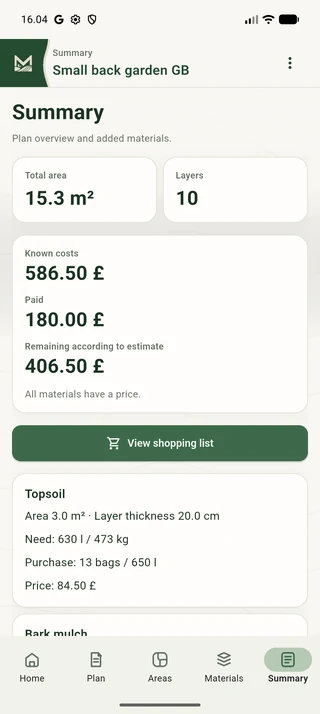
In Maavio you can record the added soil layers for different areas and bring the material quantities together in a shopping list within the same plan.
Available on Google Play

iOS version coming later in 2026.