

Calculate the internal volume first
Outside dimensions can be larger than the space the soil fills, so use the bed's internal length and width. Multiply those measurements by the intended filling depth to get a volume in cubic metres. You can convert cubic metres to litres by multiplying by 1,000.
Basic formula: internal length × internal width × growing depth = growing-medium volume.
Frame size and number of layers
Raised garden beds come in many sizes. Examples include around 120 × 80 cm and 120 × 240 cm, but the actual internal dimensions vary between products. Measure the frame you are using before ordering.
One frame gives one filling height. Stacking two or more frames increases the internal height and potential soil volume, but also raises the question of whether the plants need the full depth. Shallow-rooted crops do not need the same space as deep-rooted plants.
How deep should the growing medium be?
The filling depth depends on the plants and on whether the bed sits on the ground or is partly sunk into it. The soil does not always need to reach the top edge if the plants have enough suitable growing space at a lower level.
Use plant and supplier guidance when choosing garden soil, compost or another growing medium. A thicker layer alone does not fix poor drainage, compacted ground or an unsuitable growing environment.
Worked example
Suppose the internal dimensions are 1.2 m × 0.8 m and the intended growing depth is 0.25 m.
1.2 m × 0.8 m × 0.25 m = 0.24 m³
0.24 m³ is 240 litres of growing medium. If a second frame of the same height increases the depth to 0.50 m, the volume becomes about 0.48 m³, or 480 litres.
When estimating the order, consider settling, any shortfall and whether the supplier states the amount as loose volume or by the bag.
Lower layers and the ground beneath
If the bed sits directly on the ground, loosen the surface and make sure water can move away before filling it. Do not seal the base with an impermeable material without a specific reason, because excess water needs a way out.
The growing medium must be chosen for the plants. Unsuitable filler must not replace the root volume and growing-medium depth that plants need. Some fill materials may settle over time, so their suitability and amount have to be judged for the site. A suitable lower-layer fill can be used where it fits the structure and the plants, while the required growing-medium depth remains part of the calculation. Follow the plant and growing-medium product instructions.
Common mistakes
- Outside dimensions are used even though the internal space is smaller.
- One frame and two stacked frames are treated as having the same depth.
- Soil is ordered from nominal dimensions without deciding the growing depth.
- The same medium and depth are assumed to suit every plant.
- Settling and the actual volume of bags or loose delivery are ignored.
Plan your garden project with Maavio
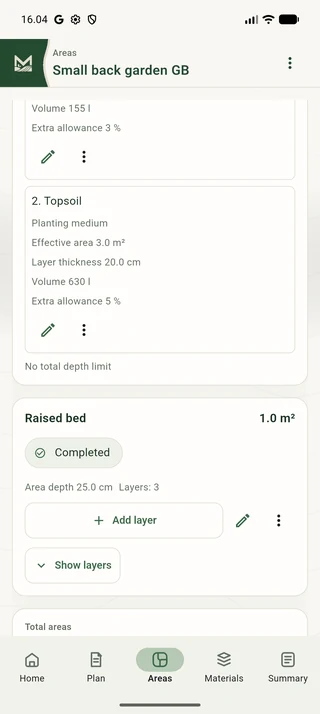
Maavio is a garden-planning app that keeps areas, material layers and quantity calculations together. Build a shopping list from your materials and follow the project’s progress in the same plan, from planning to implementation.
Available on Google Play

iOS version coming later in 2026.