

Finished growing-medium depth is not the same as new soil
A guideline for total growing-medium depth describes the finished layer after the site has been prepared. It does not automatically mean that the same amount of new soil must be delivered. Existing soil may sometimes remain or be mixed in if it suits the plants, drainage and project.
Keep two decisions separate: how deep the finished growing medium should be, and how much of that volume actually needs to be added or replaced.
Depth examples and what they describe
Choose the depth for the plants, growing medium and site. These examples come from Finnish manufacturer Kekkilä; they are not a common British or Australian specification:
- Lawn: about 20 cm of suitable, compacted growing medium in the manufacturer's lawn-establishment instructions, with different provision in some site conditions.
- Perennials: 40–60 cm in the Istutusmulta ZERO product guidance; 20–30 cm for groundcover perennials.
- Shrubs: 40–60 cm in the same product guidance.
- Trees: 60–80 cm in the same product guidance.
These figures describe suitable finished growing-medium depth in the source's context. They do not define an automatic imported layer or planting-hole depth. Plant choice, root ball, existing soil and water flow determine how they apply.
Topsoil, compost and potting mix are not interchangeable simply because they are sold for gardens. Choose the actual product for its intended use.
Estimate how much new growing medium is needed
First decide whether existing soil will stay, be mixed in or be removed. Then calculate the area that will actually be filled and the new layer depth needed. Do not automatically fill the entire planned depth with purchased soil. Check the root collar, finished level and water flow as well.
Example: finished layer and added quantity
Assume a 24 m² area needs a total 20 cm of suitable finished growing medium. If 8 cm of usable existing soil can remain within that planned layer, the added depth is 12 cm. These are calculation assumptions, not a site assessment.
Whole layer: 24 m² × 0.20 m = 4.8 m³ = 4,800 litres.
Added layer: 24 m² × 0.12 m = 2.88 m³ = 2,880 litres.
The first figure describes the total finished layer. The second is the geometric volume of its new portion. Ask the supplier what delivered quantity will produce that portion and how product settling is included. This subtraction concerns usable soil within the planned layer; soil beneath an open raised bed does not fill the bed's empty frame.
Planting holes, subsoil and water flow
A deeper growing medium does not automatically solve compacted subsoil or standing water. Check soil structure, falls and drainage before ordering material. For trees, a broad and functioning root zone is more useful than a narrow deep hole that holds water.
Checks before ordering soil
- Which plant or use is the area intended for?
- Which product and finished growing-medium depth suit the site?
- Does the measured area actually correspond to the area being filled?
- Will existing soil stay, be mixed in or be removed?
- How will water flow, and what finished level is needed?
- What order quantity and settling guidance does the supplier give?
Plan your garden project with Maavio
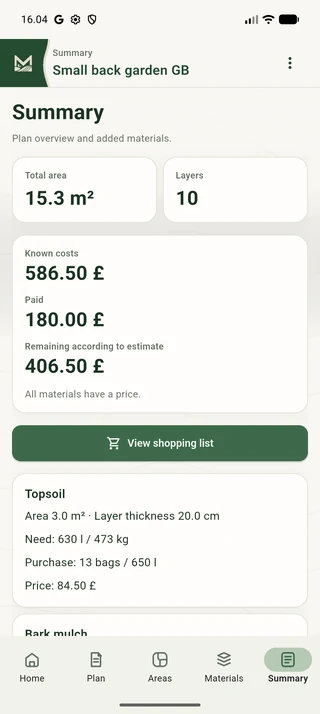
In Maavio, record the added layer depth for each area and keep the calculated material quantities and purchases in the same plan.
Available on Google Play

iOS version coming later in 2026.