

Quick answer: area × depth
Measure the area that will be covered. For a rectangular area, area is length × width; split an irregular area into smaller parts if needed and add them together.
Basic formula: area (m²) × mulch depth (m) = bark mulch (m³).
Convert the finished layer's cubic metres to litres by multiplying by 1,000. Check the required nominal litres against the product's coverage instructions, divide that amount by the bag size, and round up to whole bags.
Choose mulch depth for the use
Choose the depth for the use and the actual product's instructions. The 5 cm in this guide is a calculation example, not a universal mulch-depth recommendation.
Use only a thin layer around trunks and plant bases. Do not pile bark mulch against a trunk; keep the root collar visible or follow the plant and product instructions. Mulch does not replace the growing medium the plants need.
Bark mulch can settle and break down over time. Treat possible top-ups as later maintenance instead of adding unnecessary thickness at the start.
Example: cubic metres, litres and bags
Assume the planting area is 18 m² and the selected mulch depth is 5 cm, or 0.05 m.
18 m² × 0.05 m = 0.90 m³.
0.90 m³ × 1,000 = 900 litres.
The bag calculations below assume that the product's coverage instructions give an order requirement of 900 nominal litres.
900 litres ÷ 50 litres/bag = 18 bags, nominally 900 litres.
For hypothetical 40-litre bags, 900 ÷ 40 = 22.5 → 23 bags. Their nominal total is 920 litres, which is 20 litres more than the calculated volume. Neither bag size is an international standard; use the pack volume of the chosen product.
The 20 litres come from rounding to whole bags. They are not automatically an allowance for settling, spreading losses or a future top-up. Check the product's coverage instructions to see how nominal bag volume relates to the planned layer.
Bags or loose material?
Bags often suit a small or irregular area where the material is spread gradually and the bag size is known. Loose material or a bulk bag can make more sense as the area grows. Give the supplier the area, mulch depth and calculated volume. Confirm what the stated delivery volume means and whether it covers the planned layer.
Do not compare, for example, the nominal litres in bags directly with a lorry's tonnes without product information. Bark mulch is a different product from topsoil, compost and aggregate, so the ordering unit and coverage must be checked for each product.
Keep growing medium and mulch separate
In a planting area, bark mulch finishes the soil surface and can reduce drying and weed germination. The growing-medium depth needed by the roots should be calculated separately.
Plan your garden project with Maavio
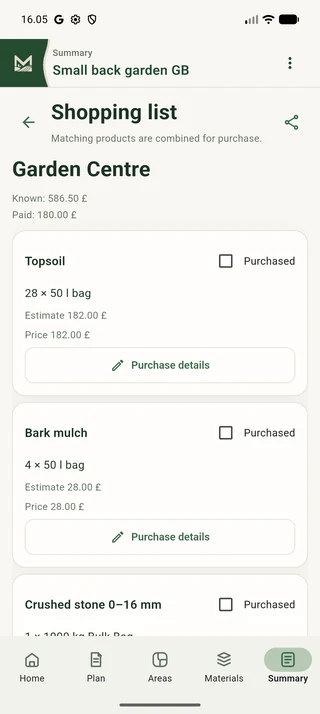
In Maavio, keep growing medium and bark mulch as separate layers in the same bed so their depths, quantities and purchases do not get mixed together.
Available on Google Play

iOS version coming later in 2026.