

How much does 1 m³ of soil weigh?
One cubic metre of soil is always 1,000 litres, but the weight depends on whether the soil is sold in a bag, a Bulk Bag or loose. In one product example, a 40-litre bag weighs about 17.5 kg and a 50-litre bag about 22.7 kg. A 1,000-litre quantity of the same bagged soil would weigh about 440–455 kg.
Loose soil and a 1,000-litre Bulk Bag are in practice loads of hundreds of kilograms per cubic metre. At a supplier-stated loose density of 450 kg/m³, 1 m³ weighs approximately 450 kg in the calculation, but moist, heavier or more compact soil may weigh more. For trailer planning, that is already a load of hundreds of kilograms before the trailer and any other load are included.
Reliable weight estimate: use the weight in the packaging or product information for the exact product you are ordering, or the loose density stated by the supplier. There is no single general “soil weight per cubic metre”.
How to convert volume into weight
Once the product density is known, the calculation is straightforward. Convert litres to cubic metres first: 1,000 litres = 1 m³. Then multiply the volume by the density.
Volumelitres ÷ 1,000 = m³
Weightm³ × density kg/m³ = kg
Bag quantitynumber of bags × product weight = kg
For example, 0.75 m³ of a product with a supplier-stated density of 450 kg/m³ weighs approximately 338 kg in the calculation. This is an example using the selected density, not a general recommendation for all soil.
Examples of 40- and 50-litre bags
Product-specific pack weights show why bag size alone is not enough. The product information for Kekkilä Puutarhamulta states a net weight of 17.54 kg for a 40-litre pack and 22.72 kg for a 50-litre pack.
40 l17.54 kg / bag
5 × 40 l87.70 kg
50 l22.72 kg / bag
10 × 50 l227.20 kg
These are examples based on one product's information. A 1,000-litre bagged quantity would be 25 × 40 litres, or approximately 438.5 kg, or 20 × 50 litres, or approximately 454.4 kg, according to those figures. This does not mean that every garden soil weighs 440–455 kg per cubic metre.
How much does bulk soil weigh?
For bulk soil, ask the supplier for the weight of the load or loose material for the exact product. If the supplier gives an example loose density of 450 kg/m³, 1 m³ weighs approximately 450 kg in the calculation and 1.5 m³ approximately 675 kg. Transport and delivery cost and suitability still depend on the supplier's product information.
Keep two things separate: the geometric volume of the planned area and the loose quantity ordered from the supplier. Growing medium can settle as it is watered and stabilises, and packed or loaded soil does not always behave like the calculated volume of a finished layer.
Wet soil weighs more than dry soil
Water adds mass to the material. The same product batch can therefore weigh differently at different times even when the nominal volume is the same. The amount of organic matter, structure and density also affect how much water the pores can hold.
When comparing product information, check whether it refers to net weight, gross weight, dry weight or the weight of material delivered while moist. If weight matters for transport or lifting, confirm the value with the supplier and do not mix dry and moist density values.
Weight when planning transport and delivery
For an order, the important information is not only the cubic quantity but also how the product is delivered. Bags can be counted using the pack weight. For bulk soil, ask for the total load weight, estimated moisture or loose density, and whether the quantity is given loose or compacted.
- Check the product name and pack size, because different mixes may be sold under similar names.
- Calculate total bag weight from the product's stated weight, not a general estimate.
- Check weight limits for the vehicle and trailer, as well as for lifting equipment and the delivery location.
- Ask the supplier how moisture and settling affect the loose quantity.
If you first need to calculate soil quantity: How much topsoil do I need? helps you calculate volume from area and layer depth. This guide takes the next step: it converts volume into weight using product density or pack weight.
Soil quantity and weight in Maavio
With Maavio you can define or draw an area, add a soil material, calculate volume from area and layer depth and see the litre quantity. If the supplier provides a suitable density, Maavio can calculate and display a weight estimate from the material quantity and density. You can adjust the material density to match product-specific information more closely.
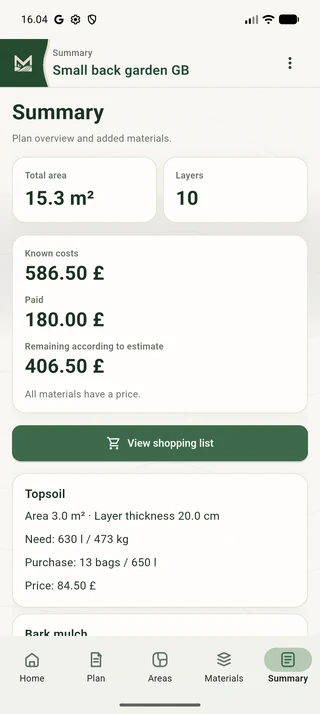
Plan your garden project with Maavio
Maavio is a garden-planning app that keeps areas, material layers and quantity calculations together. Build a shopping list from your materials and follow the project's progress in the same plan, from planning to implementation.
Available on Google Play

iOS version coming later in 2026.