

Calculate the geometric volume first
Measure the area to be filled and decide which finished layer you are calculating. Use the finished layer thickness in metres and the area in square metres. The result is the geometric volume of the planned finished layer.
Basic formula: area × layer thickness = geometric volume.
Example of an aggregate quantity
If the area is 20 m² and the finished layer is planned to be 15 cm thick, the calculation is:
Finished layer20 m² × 0.15 m = 3 m³
Example weight at the supplier's density3 m³ × 1.6 t/m³ = 4.8 tonnes
Three cubic metres is the geometric volume of the finished layer. 1.6 t/m³ is only an illustrative supplier density, not a universal value or automatically the loose quantity to order.
The same volume can weigh differently depending on the product's grading, moisture and loose density. The amount to order is also affected by how the material is compacted.
Aggregate names and products vary
Crushed aggregate or crushed rock often has a role in load-bearing or levelling layers, while gravel and finer products can have other roles depending on the construction. Terminology varies by region: fine aggregate used beneath paving may be sold as crusher dust, stone dust or a similar local product.
Product names and grading vary between suppliers. Choose the material for the intended layer, ground conditions, loading, water flow and supplier or product instructions rather than by name alone.
Why cubic metres do not convert directly to tonnes
Cubic metres measure volume and tonnes measure weight. For many aggregate products, loose density is broadly in the order of 1.4–1.8 t/m³, but the range is product-specific. How the material is loaded and compacted can also affect the delivered quantity.
When ordering by weight, give the supplier the area, layer thickness, intended use and calculated volume. Ask them to confirm the product-specific conversion instead of applying one density value to every aggregate.
Compaction and order margin
A load-bearing layer is commonly compacted in stages according to the construction and material instructions. How much the volume changes depends on the material, subgrade, layer thickness and working method. There is no universal percentage that suits every aggregate or site.
Allow for waste and final adjustments only as appropriate for the site and supplier guidance. Keep the geometric volume of the finished layer separate from the loose quantity that must actually be ordered.
Quick checks before ordering
- Is the area measured in square metres and the layer thickness converted to metres?
- Are you calculating a finished layer or a loose delivery volume?
- Have the product, grading and role in the layer been confirmed with the supplier?
- Have you checked whether the material needs compaction and which instructions apply?
- Has any waste or final adjustment been assessed without inventing a standard percentage?
Paving ground preparation is easier to plan when each layer is treated as its own quantity and the supplier's product information is kept with the calculation.
Plan your garden project with Maavio
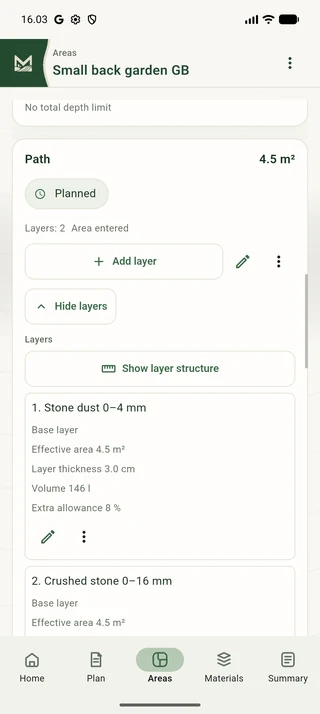
Maavio is a garden-planning app that keeps areas, material layers and quantity calculations together. Build a shopping list from your materials and follow the project’s progress in the same plan, from planning to implementation.
Available on Google Play

iOS version coming later in 2026.