

The ground preparation matters more than the pavers alone
There is no single paving structure for every site. Ground type, frost conditions, water flow, traffic load, intended use and the paving product's instructions all affect how much ground is removed and which layers are needed.
Think in layers: the pavers, base layer, bedding layer, edge restraints and falls work together. Changing one layer's thickness also changes the material quantity.
1. Check the ground, drainage and load
Find out whether the subgrade is clay, sand, glacial soil or organic material. Check whether water collects on the surface or runs towards a building. Frost-susceptible or poorly drained ground usually needs more attention to the structure than a dry, naturally firm subgrade.
A footpath, patio and vehicle driveway do not necessarily need the same construction. Choose the structure for the use, local ground conditions and the supplier's or designer's instructions.
2. Build the layers for the site
Load-bearing base layer
The base layer spreads the load and creates a stable support. Crushed aggregate or crushed rock is common, but the grading and thickness depend on the site. Organic soil and soft areas need to be removed or dealt with as part of the plan.
Compact a suitable base layer in several stages with appropriate equipment. Do not try to compact a very thick base layer in one operation, because the lower part may remain loose.
Bedding layer
The bedding layer evens the surface beneath the pavers. Crusher dust, stone dust or another fine aggregate may suit some constructions, but follow the instructions for the actual paver and bedding product.
Treat the bedding layer separately. There is no universal pre-compaction or working method for it: the correct handling depends on the paving system, material and product instructions.
3. Plan falls and edge restraints
The paved surface should direct water away from buildings and other sensitive areas in a controlled way. The exact fall depends on the building, surface material and drainage solution, so check the value required for the site. Form the fall in the layers rather than trying to correct it with the pavers.
Edge restraints stop pavers spreading sideways. Install them on a stable support and consider how they meet the other surfaces in the garden.
4. Estimate material quantity layer by layer
Calculate each construction layer as its own part. The basic formula is area × layer thickness = volume. For a 24 m² area, a finished 0.15 m crushed-aggregate layer has a geometric volume of 3.6 m³. That describes the planned finished layer, not the loose quantity automatically ordered from a supplier.
Example: 24 m² × 0.15 m = 3.6 m³ finished layer.
Cubic metres cannot be converted directly to tonnes without the loose density of the specific product. The order quantity is also affected by the material, compaction and the supplier's way of stating quantities. Use the product information and ask how the stated amount accounts for these factors.
Common mistakes
- Soft or organic subgrade is left beneath the load-bearing base.
- A standard layer structure is copied onto ground with different conditions or loading.
- The base layer is not compacted in stages.
- The bedding layer is treated with a general method without checking the paving or product instructions.
- The fall is too small or points in the wrong direction.
- Edges are left unsupported, allowing the pavers to spread.
If the site has frost, drainage or settlement problems, ask for a local professional assessment.
Plan your garden project with Maavio
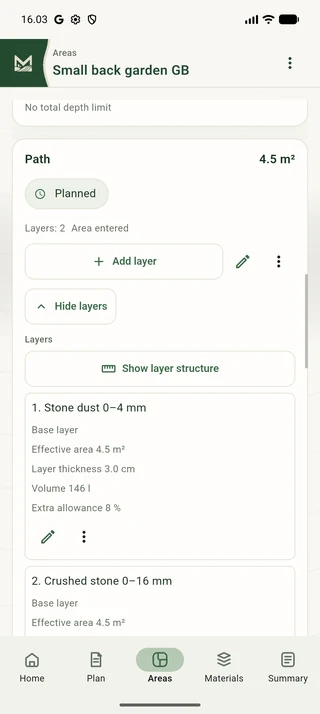
Maavio is a garden-planning app that keeps areas, material layers and quantity calculations together. Build a shopping list from your materials and follow the project’s progress in the same plan, from planning to implementation.
Available on Google Play

iOS version coming later in 2026.