

What is crusher dust and where does it fit?
Crusher dust is a fine crushed-stone material. Rudus 0/5 is an example of a product that can be used for paths, driveways, walkways and some paving surface constructions. Grading and suitable uses vary between products.
Choose the layer by its function: crusher dust can suit a surface or a specified construction, but it is not automatically a load-bearing base.
Crusher dust, crushed rock, drainage stone or gravel?
Different particle sizes have different functions. Fine crusher dust can form an even surface, crushed aggregate can be used in load-bearing or levelling layers, coarse evenly graded stone has another role, and gravel suits other surface types. Names also vary between regions and suppliers.
Choose the material for the layer function, ground, loading, water flow and product instructions. Do not replace a planned load-bearing base with crusher dust simply because it is easy to obtain.
Ground preparation determines durability
Remove soft or organic soil and check drainage, falls and frost conditions. Rudus describes, for example, a construction using 16/32 or 0/32 material, followed by 0/16 and a top layer of 0/5. That is a product and use example, not a universal layer order.
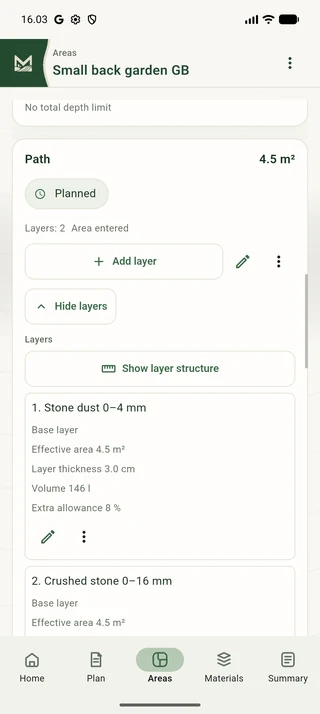
Adapt the layers and depths to the site, loading and surface. Keep the base, any bedding layer and the finished crusher-dust surface as separate material layers in the calculation.
Layer depth depends on the surface
The finished crusher-dust surface depth depends on the base, use and product instructions. For some uses Rudus mentions at least 5 cm and preferably 10 cm, with watering and compaction. Follow the advice for the actual product and construction.
If crusher dust is used as a bedding layer under pavers, follow the paving product's installation instructions. A bedding layer is not the same as a finished crusher-dust surface and has no single universal depth.
Calculate the crusher-dust quantity
First calculate the geometric volume of the planned finished layer. If the area is 20 m² and the layer is 5 cm, or 0.05 m, the calculation is 20 m² × 0.05 m = 1 m³ = 1,000 litres.
20 m² × 0.05 m = 1 m³
1 m³ × 1.6 t/m³ = 1.6 tonnes
The second step is only an example using an assumed density. Ask the supplier about the product's loose density, moisture, compaction and correct ordering unit. The geometric volume of the finished layer is not automatically the loose quantity to order.
Crusher dust does not replace growing medium
Crusher dust is a stone material, not a growing medium for roots. If the same area includes planting, plan the growing medium, crusher dust and other layers separately so that the root volume plants need is not replaced with unsuitable fill.
Common mistakes
- Crusher dust is used as a load-bearing base without the construction supporting it.
- Finished geometric volume is confused with loose order quantity.
- Tonnes are calculated without the product's density and moisture information.
- Drainage, frost and falls are not checked.
- A universal bedding depth is used without following the paving product's instructions.
- Crusher dust is confused with growing medium.
Plan your garden project with Maavio
Maavio is a garden-planning app that keeps areas, material layers and quantity calculations together. Build a shopping list from your materials and follow the project’s progress in the same plan, from planning to implementation.
Available on Google Play

iOS version coming later in 2026.