

Is the problem in the surface or the structure?
A new surface layer may be enough if the verges, crossfall and load-bearing structure work and the problem is a worn or rutted surface. Deep ruts, recurring potholes, soft spots, sinking material, standing water and frost damage suggest that the problem may be below the surface.
Before ordering: drive or walk the driveway in both dry and wet weather. Mark where water stands, the ground flexes, an edge collapses or the same pothole quickly returns after repair.
Check water flow first
Water is one of the common factors that makes driveway problems worse. Check whether surface water can leave through crossfall, edges, open ditches, culverts or another drainage solution suited to the site. Do not raise the surface so that water is directed towards a building, a neighbour's property or the wrong part of your own plot.
If the subgrade is wet or weak, adding more material alone will not solve the load-bearing problem. Water flow, subgrade quality and any geotextile or other structural solution need to be assessed together. Runoff includes rainwater and drainage water from gardens and streets, so the rest of the site's water management also needs checking.
Crushed aggregate, gravel and crusher dust are not the same
A material name alone does not tell you which layer it suits. The grading and fines content of crushed aggregate affect how the surface binds and how it withstands traffic. The difference between gravel and crushed aggregate depends on the product's grading, fines content and intended use, so the suitable layer must be confirmed from the product information. Crusher dust can suit some levelling or finishing solutions, but it is not automatically a substitute for a load-bearing structure.
See the guides how much aggregate, crushed rock or crusher dust you need, crusher dust for gardens and ground preparation for paving for more on differences and uses. This guide focuses on applying them in a driveway repair workflow.
The structure depends on the site
There is no single correct driveway layer thickness without information about the subgrade, frost susceptibility, drainage, loading, falls and the structure already in place. A light surface repair and a structural repair in wet, soft subgrade are different jobs.
Technical guidance can contain site-specific layer examples. In the Finnish Metsänhoidon suositukset technical guidance for forest roads, a 5–10 cm example is given for the forest-road wearing course and a 20–30 cm crushed-aggregate layer for repairing structural damage. These are technical examples for forest roads, not private-driveway design or sizing recommendations in the UK or elsewhere.
If the subgrade is organic, very wet, frost-susceptible or prone to settlement, ask for a local assessment of the structure. More aggregate alone will not fix the situation if water or the subgrade keeps causing the damage.
Repair workflow
- Assess the starting point. Identify potholes, ruts, soft spots, collapsed edges and water flow.
- Fix drainage. Open or clean the necessary drainage routes and prevent water from entering the structure before spreading new material.
- Remove unsuitable or damaged material if needed. If the old surface is silted up or mixed with the subgrade, a new layer alone may have a short life.
- Build or patch suitable layers. Choose the product for its role, grading and the site's instructions.
- Shape the surface. Create a working fall and connect it to verges and other surfaces in a controlled way.
- Compact according to the work instructions. Allow the layers to settle and check the result before finishing.
Compaction changes the result
A load-bearing structure is normally compacted in stages according to the material and work instructions. Compaction, moisture, grading, layer thickness and the subgrade affect how much loose material is needed before the layer is complete.
Keep the geometric volume of the finished layer separate from the loose quantity ordered from the supplier. The volume calculation describes the planned layer dimensions, while product information tells you how the product is sold and how compaction is accounted for. Do not apply one general compaction percentage to every driveway.
Calculate materials layer by layer
Once the driveway length and width are known, calculate the area: length × width. Calculate each layer by multiplying the area by the planned thickness of that layer. Treat each material as its own layer.
Arealength × width = m²
Layerm² × thickness in metres = m³
Example12 m × 3 m × 0.15 m = 5.4 m³
The 5.4 m³ example describes the geometry of a finished 15 cm layer over a 36 m² area. If the driveway has a 15 cm load-bearing layer and a 5 cm surface layer, calculate 5.4 m³ and 1.8 m³ separately. This is a calculation example, not a recommended driveway structure. Add any working allowance and waste only according to the product, site and supplier guidance.
- Does the calculated area cover the whole driveway or only the section being repaired?
- Does each layer have its own material and thickness?
- Have the finished level, edges and water flow been checked before ordering?
- Is the tonnage based on supplier product information rather than only a cubic calculation?
Driveway quantities in Maavio
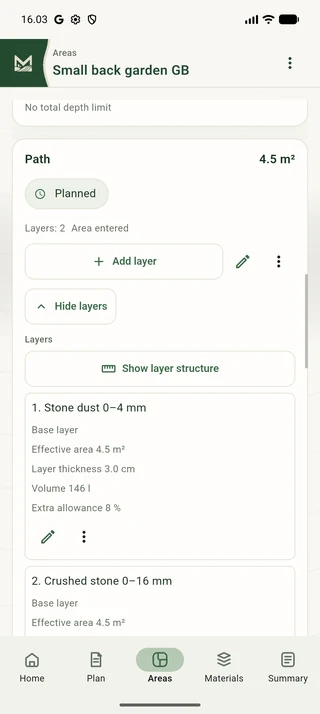
In Maavio, a driveway can be treated as an area whose surface area is the starting point for several structural layers. Add aggregate, gravel or crusher dust as separate materials, define a separate thickness for each layer and keep the quantities and shopping list in the same plan.
Plan your garden project with Maavio
Maavio is a garden-planning app that keeps areas, material layers and quantity calculations together. Build a shopping list from your materials and follow the project's progress in the same plan, from planning to implementation.
Available on Google Play

iOS version coming later in 2026.