

Plan the hedge line before digging
Mark the hedge line and check boundaries, underground services and nearby structures before you start. Allow for the hedge's future width, maintenance and relationship with the other garden areas.
There is no single standard measurement for every thuja hedge. Variety, plant size, site, soil and nursery guidance affect both plant spacing and the dimensions of the planting trench.
Most important check: use the nursery's instructions as your primary source. A general spacing or trench size does not override the needs of the particular variety and plant size.
Spacing depends on the plants and the goal
Closer spacing can create a closed screen sooner, but it requires more plants and can increase competition for water and nutrients. Wider spacing gives each plant more room, but the hedge may take longer to close.
For many thuja hedges, about 0.5 m is a useful starting spacing, but it is not a universal rule. A 10 m hedge then gives a worked example of about 20 plants. Variety, plant size, end points and nursery instructions can change the final number.
What planting trench do the thujas need?
The roots or root balls should fit without bending or being pressed, with suitable soil around them. Trench width and depth depend on root-ball size, obstacles, drainage and whether you are planting in one continuous trench or separate holes.
Clay, rock, frost or a wet hollow may require a different drainage or soil-improvement solution. Do not dig a deep hole that holds water beneath the root balls. The planting height should follow the nursery's instructions.
Spring or early autumn are often suitable planting periods when the soil can be worked and watering can be arranged. Adapt the timing to the plants, weather and nursery guidance.
Soil and growing medium
Estimate the growing-medium volume from the real dimensions of the trench or holes: length × width × depth. If some suitable existing soil remains in place, less new soil is needed than when the whole volume is replaced.
Soil quantity: length × width × depth = volume.
For example, 10 m × 0.4 m × 0.4 m = 1.6 m³. This is a calculation model, not a universal recommendation for every thuja hedge.
The soil should support rooting and a suitable balance of water and air. Do not plant the root ball deeper than instructed or shape the growing bed like a container where water can stand.
Water after planting
Water both the root balls and the surrounding soil after planting. During the first weeks, check moisture especially in dry, warm or windy weather. Watering needs depend on rainfall, soil, plant size and the time of year.
A suitable mulch can reduce evaporation, but leave space around the stems and follow the instructions for the plants and mulch product.
Common mistakes and checks
- The hedge line is marked without checking boundaries and underground services.
- Spacing is selected without considering variety, plant size and nursery guidance.
- Root balls do not fit the trench without roots being pressed.
- Water stands beneath the root balls because the subgrade is too dense.
- New soil is ordered for the full volume even though some existing soil could be used.
- Watering is stopped too early after planting.
Plan your garden project with Maavio
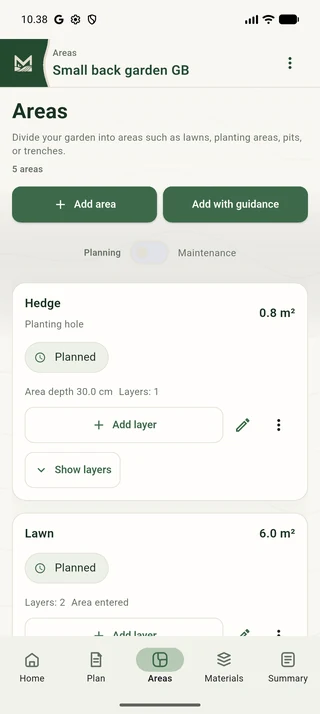
Maavio is a garden-planning app that keeps areas, material layers and quantity calculations together. Build a shopping list from your materials and follow the project’s progress in the same plan, from planning to implementation.
Available on Google Play

iOS version coming later in 2026.